Gabby Petito lives on through family’s advocacy
By Kelly Farrell
Florida Weekly
Van life was seen across TV and social media during and after the pandemic—but few if any vans caught the attention of the nation and world like that of Gabby Petito’s white Ford Transit Connect.
“Like the OJ story, the nation watched Gabby Petito’s story, and they were deeply affected. Gabby stays in people’s hearts,” said Linda Oberhaus, CEO of The Shelter for Abused Women & Children.
Petito’s white Ford Transit van of 2021 was like OJ Simpson’s white Ford Bronco of 1994, as people watched across media platforms learning of domestic violence and murder.
Gabby’s family though makes a difference. Her and stepparents, the Schmidts and the Petitos, advocate and inform about domestic violence throughout the U.S. and world, including in Naples, Friday, Feb. 20.
“It’s kind of cathartic in a way to become an advocate,” said Jim Schmidt, Gabby’s stepdad. “It’s not easy though.”
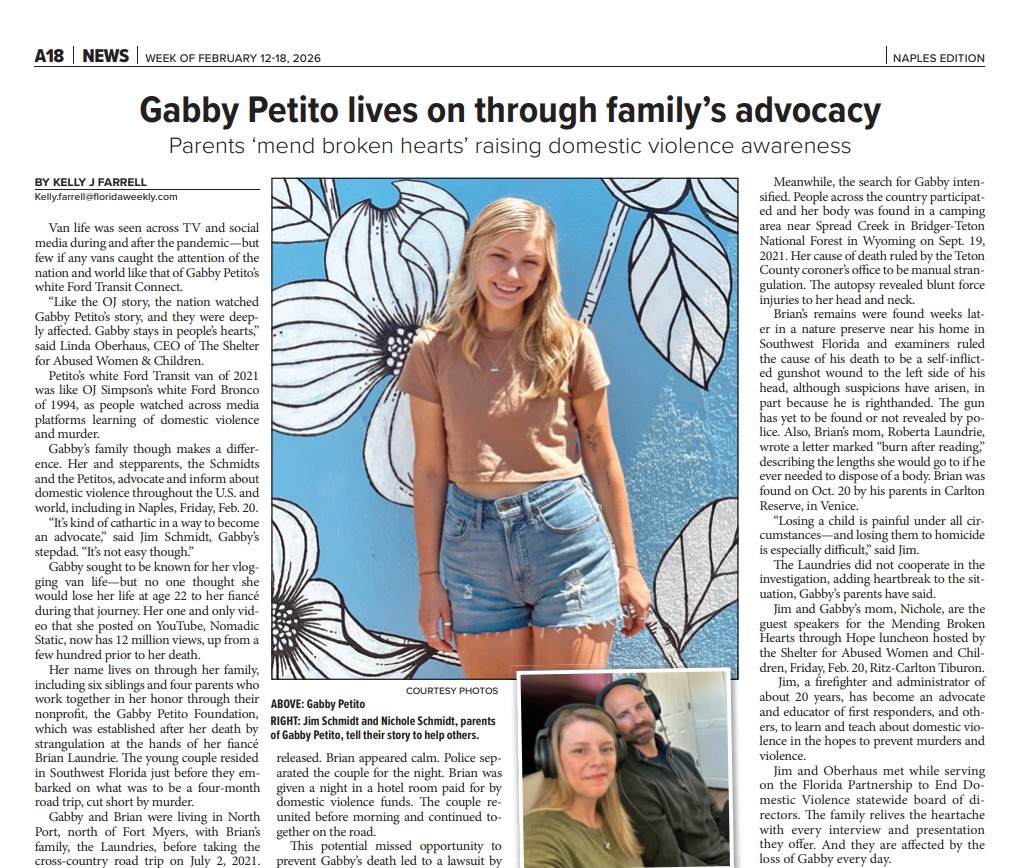
Gabby sought to be known for her vlogging van life—but no one thought she would lose her life at age 22 to her fiancé during that journey. Her one and only video that she posted on YouTube, Nomadic Static, now has 12 million views, up from a few hundred prior to her death.
Her name lives on through her family, including six siblings and four parents who work together in her honor through their nonprofit, the Gabby Petito Foundation, which was established after her death by strangulation at the hands of her fiancé Brian Laundrie. The young couple resided in Southwest Florida just before they embarked on what was to be a four-month road trip, cut short by murder.
Gabby and Brian were living in North Port, north of Fort Myers, with Brian’s family, the Laundries, before taking the cross-country road trip on July 2, 2021. They had been engaged for out a year. She and Brian had gone to high school together in Long Island, NY, later moving into Brian’s parents’ Florida home.
Their lives on the road looked picture perfect—until a 911 call and meeting with police in Moab, Utah on Aug. 12, 2021. A witness reported to police that they saw a man slapping a woman in the face. In part by license plate number, this was determined to be Brian slapping Gabby. When police spoke to the couple, Gabby and Brian described Gabby as the aggressor. Meanwhile, Gabby sobbed in the patrol car, according to bodycam footage later released. Brian appeared calm. Police separated the couple for the night. Brian was given a night in a hotel room paid for by domestic violence funds. The couple reunited before morning and continued together on the road.
This potential missed opportunity to prevent Gabby’s death led to a lawsuit by her family against the Moab police, who were protected by state immunity laws.
What happened between that police stop in Moab and Sept. 1, the day Brian returned to his parents’ home in North Port with Gabby’s van and without Gabby, has since been pieced together—largely by all-pervasive cameras, social media and mobile phone usage.
Gabby’s mom Nichole Schmidt took to social media on Sept. 11, 2021, reporting Gabby missing. She also was able to file a missing person’s report from Long Island through Suffolk County Police in New York, in part because Florida and other state’s regulations wouldn’t allow a missing person’s report of an adult. At the time, the Schmidts lived in Long Island.
The Facebook post went viral. She had the nation—and the world—on her side. Something the Schmidt and Petito families try to gift to others in their advocacy, knowing the attention was unusual.
Two days after the post, Brian went missing, on Sept. 13, though police believed he was still inside his parents’ home. At one point, police misidentified who was leaving the house, confusing Brian for his mother.
Meanwhile, the search for Gabby intensified. People across the country participated and her body was found in a camping area near Spread Creek in Bridger-Teton National Forest in Wyoming on Sept. 19, 2021. Her cause of death ruled by the Teton County coroner’s office to be manual strangulation. The autopsy revealed blunt force injuries to her head and neck.
Brian’s remains were found weeks later in a nature preserve near his home in Southwest Florida and examiners ruled the cause of his death to be a self-inflicted gunshot wound to the left side of his head, although suspicions have arisen, in part because he is righthanded. The gun has yet to be found or not revealed by police. Also, Brian’s mom, Roberta Laundrie, wrote a letter marked “burn after reading,” describing the lengths she would go to if he ever needed to dispose of a body. Brian was found on Oct. 20 by his parents in Carlton Reserve, in Venice.
“Losing a child is painful under all circumstances—and losing them to homicide is especially difficult,” said Jim.
The Laundries did not cooperate in the investigation, adding heartbreak to the situation, Gabby’s parents have said.
Jim and Gabby’s mom, Nichole, are the guest speakers for the Mending Broken Hearts with Hope luncheon hosted by The Shelter for Abused Women & Children, Friday, Feb. 20, Ritz-Carlton Tiburon.
Jim, a firefighter and administrator of about 20 years, has become an advocate and educator of first responders, and others, to learn and teach about domestic violence in the hopes to prevent murders and violence.
Jim and Oberhaus met while serving on the Florida Partnership to End Domestic Violence statewide board of directors. The family relives the heartache with every interview and presentation they offer. And they are affected by the loss of Gabby every day.
“By talking about Gabby and informing others of domestic violence, it’s a way to channel our grief,” Jim said. “It’s a really difficult conversation to have.”
Yet, it’s very rewarding to see all the people helped by the story, he said. Gabby’s father, Joe Petito, has compiled many such stories over the years to share as they will at the luncheon.
The four parents, including stepmom, or bonus mom, Tara Petito, all serve the Foundation in different ways and the Foundation supports other domestic violence related nonprofits. The parents were amicable prior to Gabby’s death and became even closer since. Gabby’s birth parents separated when she was young and both remarried, vowing then to do their best for the children.
Though Gabby’s family have used the mass attention for good, the family also grieved publicly.
They successfully turn their pain into purpose, said Oberhaus.
That’s something they don’t say everyone must do—but it was what they chose.
Gabby’s mom noted that people may forget that she and her family are not only advocates but also survivors. They too have broken hearts for the mending.
The parents continue speaking across the country, noting that domestic violence affects all socio-economic classes, religions, countries, colors and creeds, though some demographics are more commonly affected than others. Five missing person’s bodies were found while searching for Gabby. The Mending Broken Hearts event will further tell how this case continues changing the world.
“They’re not just changing lives, their saving lives,” Oberhaus said.
On social media, people tell their stories of being informed—and saved—by Gabby’s story and the work of her family. Among them recently was Alese Watters.
“Gabby Petito is who gave me the inspiration to leave my situation after 16 years. It’s sad that it came afterwards, and that the world didn’t discover her until she was gone. She was a beautiful soul. I hope her parents find some type of solace in the fact that Gabby is helping to empower women, even in the afterlife. I never spoke publicly about my situation until just recently. I truly wish I could have known her,” she wrote.
Among the lessons that save lives is learning how controlling behavior is a significant nonphysical attribute of abuse.
“When people look back at the Gabby Petito case, several common red flags stand out, not as hindsight blame, but as learning opportunities,” Oberhaus said.
These red flags of abuse include:
- Coercive control: Isolation, monitoring, manipulation and controlling behavior often precede physical violence.
- Escalation during transitions: Travel, financial stress, public scrutiny or major life changes can increase risk.
- Visible distress paired with minimization: Victims often apologize, downplay injuries or take responsibility, especially as the abuser appears calm or charming.
One of the missed opportunities at the time may have occurred in Moab, when the abuse was seen and reported. In part, Brian seemed calm and Gabby was stressed and crying.
“Victims who are emotional, anxious or apologetic may be seen as ‘unstable,’ while perpetrators who are calm or articulate may appear more credible. This dynamic can unintentionally shift protection toward the wrong person,” Oberhaus said.
Since Gabby’s murder, though, laws have changed. Utah passed legislation, often referred to as the Gabby Petito Act, strengthening lethality assessment and co-responder requirements, which are when mental health and social services are joined with law enforcement. Many states are now considering similar measures.
The Danger Assessment, developed by Dr. Jacquelyn Campbell, is a brief, evidence-based group of questions used by law enforcement and advocates to assess the risk of serious injury or homicide in intimate partner violence cases, Oberhaus described.
“It has been shown to be highly effective in identifying situations where immediate intervention is critical,” she said.
History of strangulation is among the 12 questions asked by law enforcement in the assessment, which is now required in Florida, among other states, during domestic violence related cases, following Gabby’s death. The other questions relate to threats of violence and killing; access to weapons, particularly a gun; unemployment; jealousy; and control, among others.
Gabby died from strangulation. Strangulation, or choking as people may call it, often occurs nonlethally first and becomes one of the most likely predictors of eventual murder. Strangulation can cause death in seconds— or days, weeks or even months later. Marks may not be immediately seen.
The most dangerous times are while leaving, right after leaving or when returning. Gabby and Brian had separated, with Brian camping in the tent at a distance from the van days before the murder.
Abuse often starts with “love bombing,” or extreme gifts of affection leading to dependence, and then increased control over friends, family, occupation, money and communication, Jim described.
“Over time, when exposed to this type of behavior or abuse, it actually reprograms the brain,” he said.
When in such a situation, a person becomes afraid, uncertain or unable to leave safely. They may still love the person who is harming them and may seek to protect them from law enforcement or act in other ways that could seem confusing due to the brain changes.
Jim advised not to be judgmental or forceful toward a person you suspect is dealing with domestic violence. If a person is in a controlling and abusive relationship, they’re experiencing confusion.
“Try to empower them,” he suggested. “Instead of asking pointed question, ask more open-ended question.”
Even though conversations and education surrounding domestic violence may be difficult, it is important. So too are aspects of healthy relationships and healthy boundaries, said Jim and Oberhaus.
As Jim concluded the interview on Friday, he thought of the person who inspires him to keep speaking about domestic violence prevention and awareness—his stepdaughter, Gabby.
“I think she sends us signs daily. She’s very strong. She’s guiding us to keep telling her story and as we do, she’ll always live on.”
In The KNOW:
26th annual Mending Broken Hearts with Hope Luncheon
- When: 11 a.m. Friday, Feb. 20
- Where: The Ritz-Carlton-Tiburon, 2600 Tiburon Drive, Naples
- Tickets: Tickets start at $400. Visit naplesshelter.org
- Information: Contact Susan Utz, sutz@naplesshelter.org
DOMESTIC VIOLENCE RESOURCES
If in immediate danger, call 911
24-hour emergency hotlines: Shelter for Abused Women & Children of Collier County, 239-775-1101; National Domestic Violence Hotline, 1-800-799-7233 (SAFE).
- Text: National DV Hotline can be contacted by text: Text LOVEIS to 22522, offering 200 languages.
- Native Americans have higher rates of missing, murdered and abused women than Americans on average. For 24/7 culturally appropriate domestic violence help, call 1-844-7NATIVE (1-844-762-8483) or go to StrongHeartsHelpLine.org and Chat Now.
- Men’s contact: Counseling of Southwest Florida is the only certified intervention program for men in Collier County, counselingswfl.com, 239-775-0039.